Know where to invest your energy, you move faster, smarter, and with purpose.

Impact-Effort Matrix

You’ve got a concept that could change the game—but here’s the truth: not all ideas are created equal. Some will skyrocket with minimal effort, while others will drain resources without delivering real impact.

How do you know which is which?


Enter the Impact-Effort Matrix—your ultimate decision-making weapon. This isn’t just a chart; it’s a clarity machine that cuts through the noise and shows you where to focus for maximum results.

What It Is

The Impact-Effort Matrix is a simple yet powerful decision-making tool that helps you prioritize ideas based on their potential impact and the effort required to implement them. Think of it as your innovation GPS—it tells you where to go first and what to avoid so you don’t waste time or resources.

Why It Matters

Innovation isn’t just about big ideas—it’s about smart execution.
The Impact-Effort Matrix helps you:
✅ Focus on what moves the needle for your organization and the CDFI ecosystem.
✅ Avoid resource traps that drain time and money without delivering results.
✅ Build momentum fast by tackling quick wins first.
When you use this tool, you’re not just brainstorming—you’re strategically shaping a solution that’s feasible, scalable, and ready for replication or adoption.

How It Works

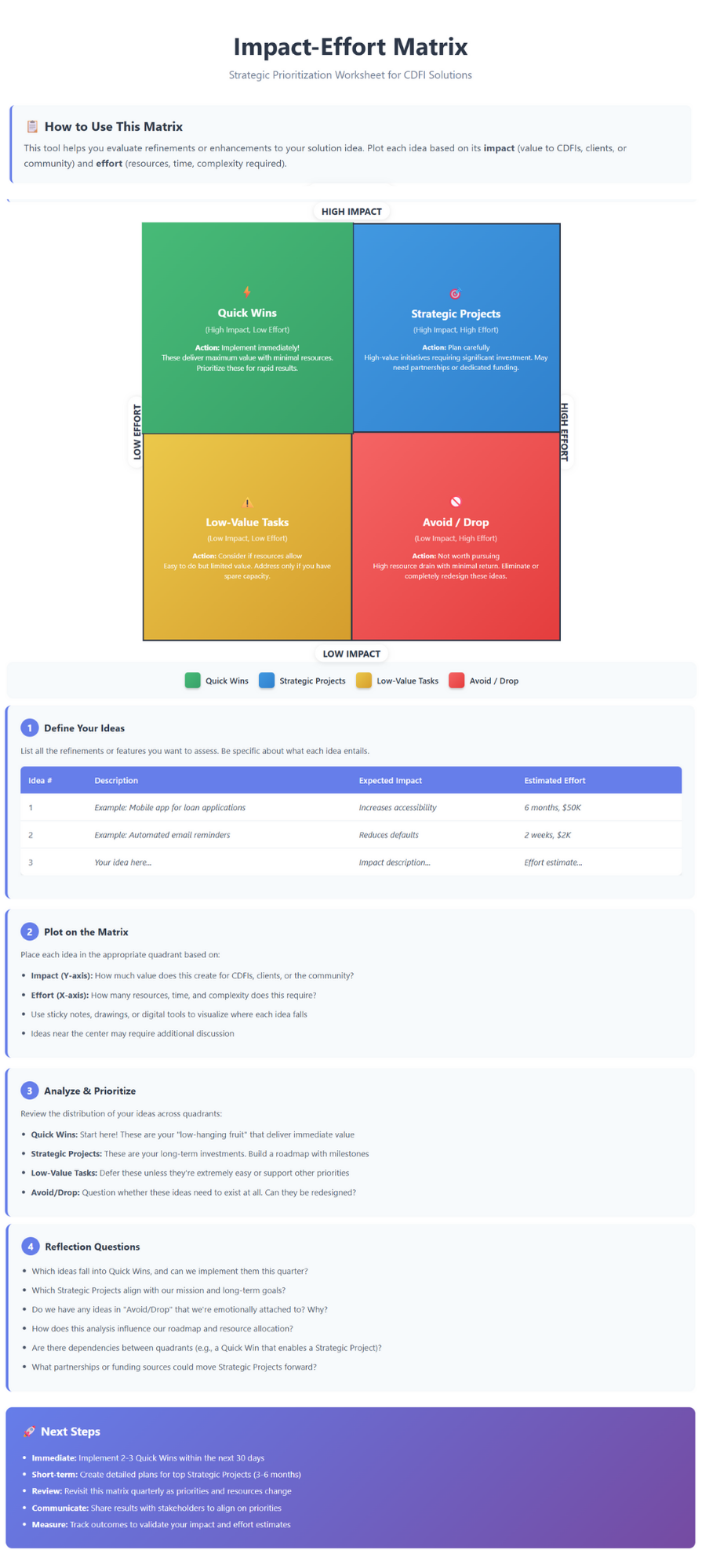
Picture a 2x2 grid with two axes:

  • Impact (vertical): How much value will this idea deliver to CDFIs, clients, or communities?
  • Effort (horizontal): How much time, money, and complexity will it take to make it happen?

You’ll plot your refinements or features into one of four quadrants:
  1. Quick Wins (High Impact, Low Effort): Your low-hanging fruit—do these NOW.
  2. Strategic Projects (High Impact, High Effort): Worth the investment—plan for these.
  3. Low-Value Tasks (Low Impact, Low Effort): Optional—only if resources allow.
  4. Avoid / Drop (Low Impact, High Effort): Say goodbye—these aren’t worth it.
Empty space, drag to resize
When exploring your solution, use this tool to identify the feasibility:
01

Identify Elements

Identify the different aspects, features or needs for your solution to be fully adopted.
02

Plot

Plot into one of four quadrants:

  1. Quick Wins (High Impact, Low Effort): Your low-hanging fruit—do these NOW.
  2. Strategic Projects (High Impact, High Effort): Worth the investment—plan for these.
  3. Low-Value Tasks (Low Impact, Low Effort): Optional—only if resources allow.
  4. Avoid / Drop (Low Impact, High Effort): Say goodbye—these aren’t worth it.
03

Plan

Identify your Quick Wins and Strategic Projects.

Build momentum by acting on what matters most.
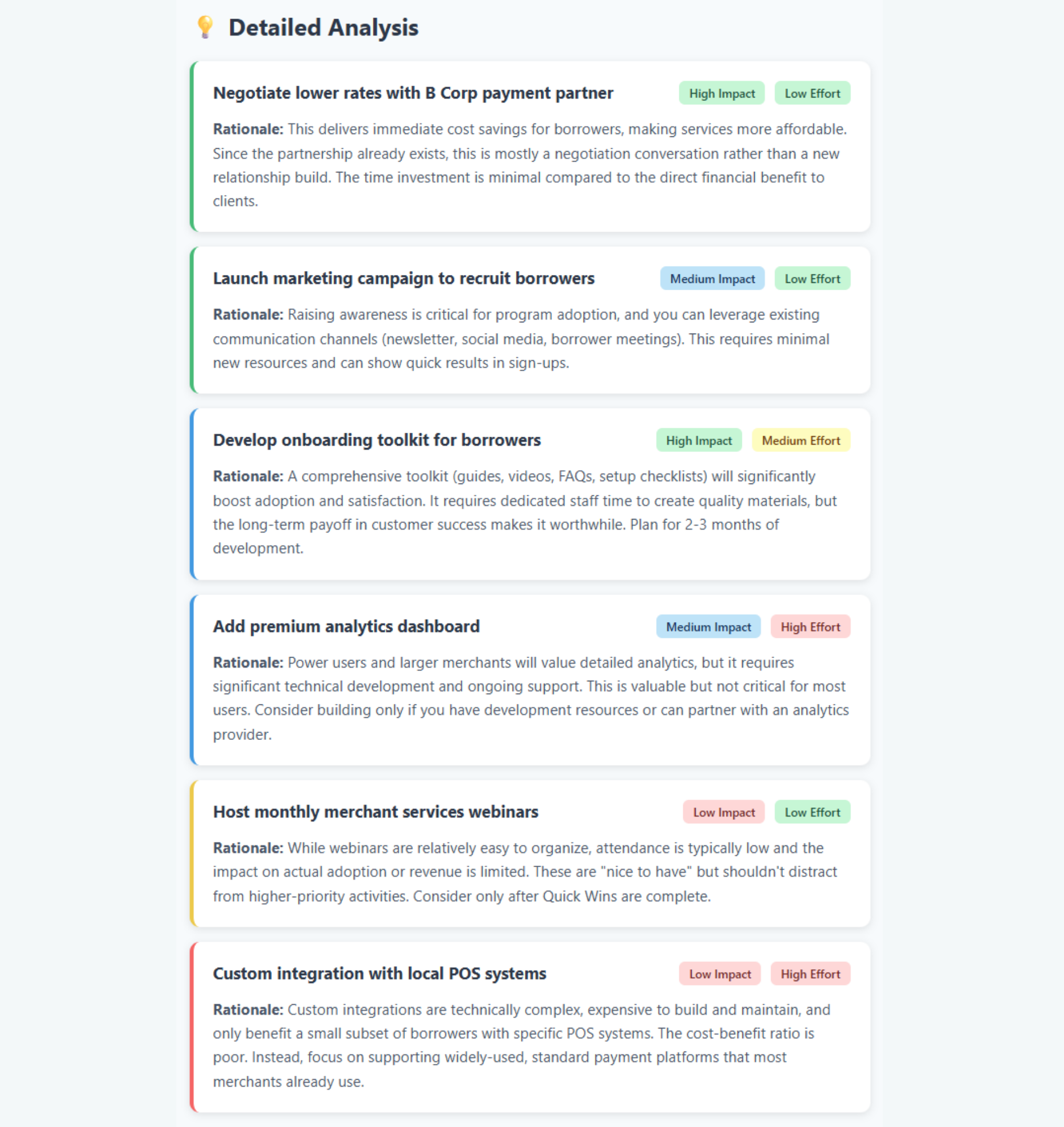
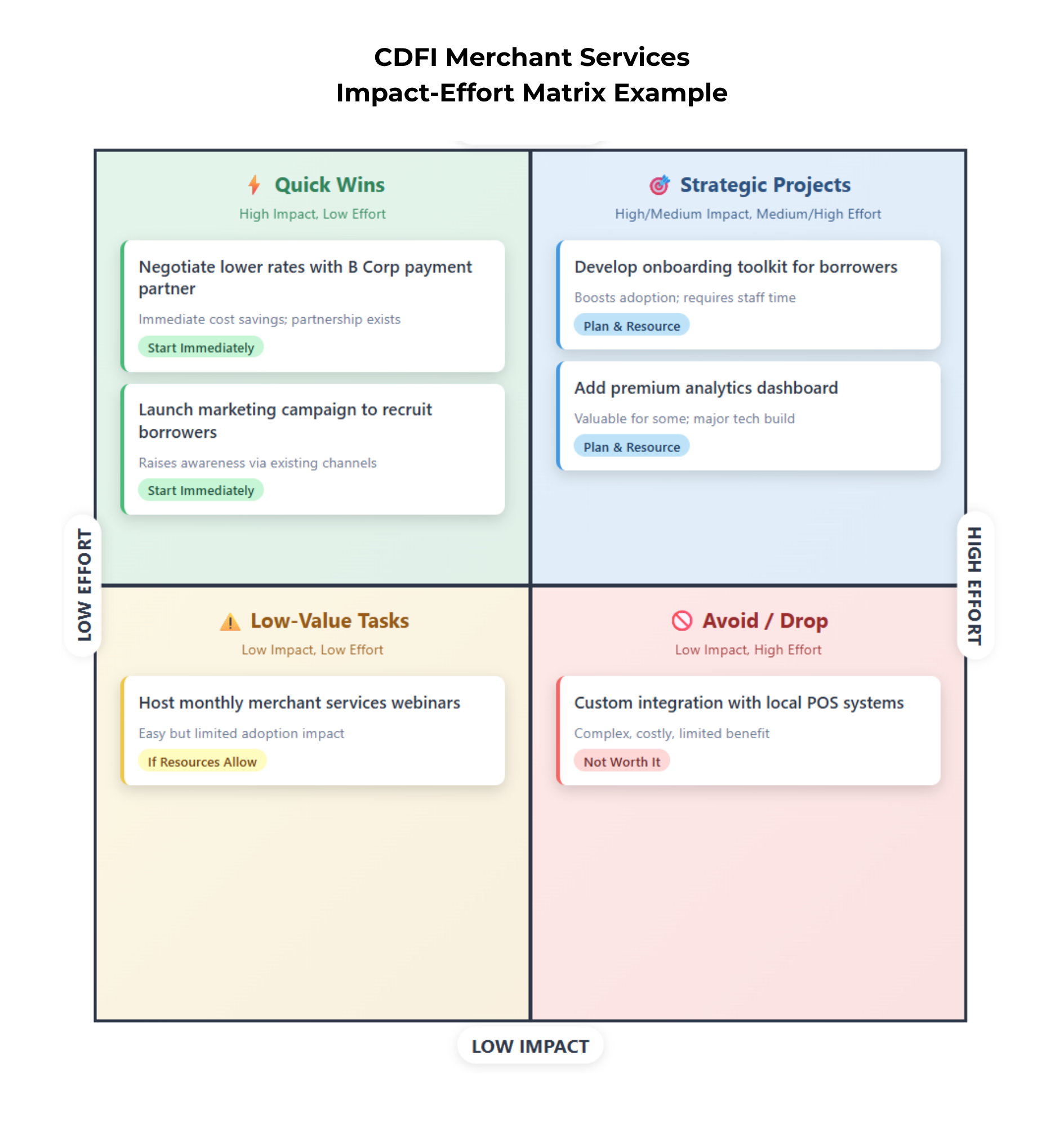
Example That Hits Home    

CDFI Merchant Services

Recommended Action Plan

Immediate Actions (Next 30 Days)
Negotiate lower rates: Schedule meetings with your B Corp payment partner to discuss volume discounts or reduced fees for CDFI borrowers
Launch marketing campaign: Create email templates, social media posts, and borrower meeting talking points to promote the merchant services program
Set success metrics: Define KPIs for both initiatives (e.g., % rate reduction, # of new merchant sign-ups)

Strategic Planning (3-6 Months)
Onboarding toolkit: Assign a project team and timeline to develop comprehensive onboarding materials. Start with the most common pain points
Analytics dashboard: Conduct user research to validate demand. If justified, explore build vs. buy options and partnership opportunities
Secure resources: Include both projects in your next budget cycle or grant applications

Skip or Defer
POS integrations: Eliminate from roadmap. Focus on standard payment solutions instead
Monthly webinars: Defer until after Quick Wins and Strategic Projects are complete. Consider quarterly webinars instead if you have capacity

Review & Iterate
Revisit this matrix quarterly as you gain data on actual impact and effort
Track time and cost for each initiative to improve future estimates
Stay flexible—ideas may move between quadrants as circumstances change